


If you want stable production and fewer resource bottlenecks in Anno 117: Pax Romana, you will need to learn how the ratios of production work. The system is simple in concept: every chain has a rhythm in this game, and it is your job to set the speed at which the buildings that gather the raw materials do so in relation to the buildings refining them. Once the timing lines up, you get a smooth, efficient supply line without shortages or waste.
Below is a clear explanation of how production ratios work, followed by the best ratios for Albion and Latium.
What is a Production Ratio in Anno 117: Pax Romana?
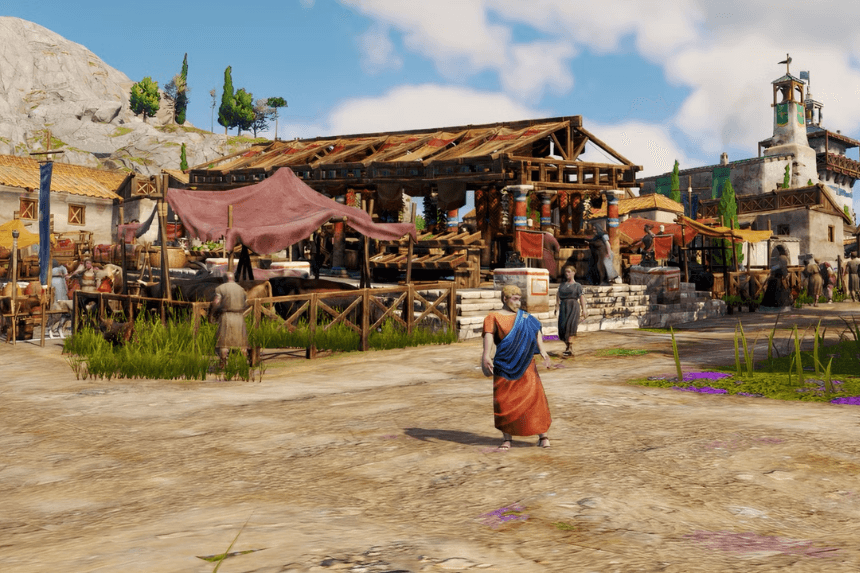
One way of looking at a production ratio is to consider it a measure of how balanced your supply chain is. If the number of inputs produced within a given period is equal to the number of outputs processed within the same period of time, then you have reached a 1:1 production ratio.
The Woodcutter to Sawmill chain is a simple example.
A Woodcutter produces one thousand units of wood in roughly thirty seconds.
The Sawmill also requires an equal amount of wood and takes the same thirty seconds to process into timber.
Those timings line up perfectly, which makes this chain a clean 1:1 setup.
Not every chain in the game needs to be built this way. Mid and late game production often pulls from multiple sources at different speeds. Some chains only unlock once you move into the third tier, and at that point, it becomes normal to combine several input buildings to keep one output building running non-stop.
In the earliest stages, it is usually better to stick with simple, predictable setups. Once your city expands, you can start building hybrid or high-throughput chains that rely on more advanced ratios.
Albion Province – Optimal Production Ratios

| Final Product | Value Chain 1 | Production Chain 2 | Production Chain 3 |
| Shoe Weaver (2) | Reed Gatherer (1) | ||
| Bakery (2) | Wheat Farm (2) | Donkey Mill (2) | Charcoal Burner (1) |
| Salsicium (2) | Pig Farm (1) | Herb Garden (3) | Charcoal Burner (1) |
| Fibularium (4) | Silver Mine (1) | Silver Forge (2) | Charcoal Burner (2) |
| Potter 2 | Mud Driver (3) | Resin Tapper (2) | Charcoal Burner (1) |
Latium Province – Optimal Production Ratios

| Final Product | Chain 1 | Chain 2 | Chain 3 | Chain 4 | Chain 5 | Chain 6 |
| Marble Mason 3 | Marble Quarry (2) | |||||
| Ropemaker (2) | Hemp Farm (1) | |||||
| Sailmaker 3 | Sheep Farm (1) | |||||
| Pileus Felter (2) | Sheep Farm (1) | |||||
| Olive Press (3) | Olive Grower (4) | |||||
| Tiler (2) | Clay Pit (1) | Charcoal Burner (1) | ||||
| Concrete Mixer (6) | Limestone Quarry (2) | Sand Refinery (3) | ||||
| Garum Works (3) | Schomber’s Shack (2) | Salt Ponds (1) | ||||
| Vitner 1 | Vineyard (2) | Apiary (1) | ||||
| Tabulus (8) | Sandrac (6) | Apiary (3) | ||||
| Weaponsmith (3) | Iron Mine | Furnace (2) | Charcoal Burner (2) | |||
| Bakery (2) | Wheat Farm (2) | Flour Mill (1) | Charcoal Burner (1) | |||
| Sandal Maker (4) | Tannery (2) | Pig Farm (1) | Salt Ponds (1) | |||
| Potter (2) | Clay Pit (1) | Resin Tapper (2) | Charcoal Burner (1) | |||
| Soap Maker (2) | Pig Farm (1) | Lavender Grower (4) | Renderer (2) | Charcoal Burner (1) | ||
| Loom Weavery (2) | Weaver 4 | Dye Works (4) | Snailery (3) | Flax Farm (3) | ||
| Glassblower 8 | Mineral Quarry (3) | Sand Refinery (3) | Mineral Crusher (4) | Glass Smelter (6) | Charcoal Burner (4) | |
| Armourer (3) | Charcoal Burner (2) | Furnace (2) | Tannery (2) | Pig Farm (1) | Salt Ponds (1) | Iron Mine (1) |